Pakistan, Uzbekistan share centuries-old cultural, literary bonds: Aurangzeb Khichi

Federal Minister for National Heritage and Culture, Aurangzeb Khan Khichi on Thursday said that Pakistan and Uzbekistan were connected through centuries-old cultural, literary and spiritual ties deeply rooted in shared history and civilization.
The minister highlighted that the historic cities of Samarkand and Bukhara represented a common literary and historical heritage between Pakistan and Uzbekistan.
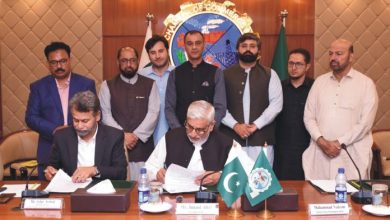
Federal Minister for National Heritage and Culture, Aurangzeb Khan Khichi said this while addressing the book launching Cermony titled “Short Stories of the 20th Century and Urdu- Uzbek Similar Words Dictionary”, along with Ambassador of Uzbekistan to Pakistan, H.E Alisher Tukhtaev and others speakers.
Aurangzeb Khan Khichi noted that Uzbekistan-Pakistan rich legacy was spiritually and culturally linked with Lahore, the heart of Pakistan’s literary and artistic traditions.
The Minister said the shared heritage of the two countries reflected centuries of interaction in the fields of Sufism, poetry, art and literature.
He added that the fragrance of this civilizational connection could still be felt today despite the passage of time.
The minister emphasized that Uzbekistan and the wider Central Asian region have maintained a distinguished relationship with Pakistan across generations.
He said these historical and cultural links were now being transferred to the younger generation, making it essential for both nations to work collectively for further strengthening and preserving these bonds.
He observed that poets, writers and scholars on both sides have played a vital role in promoting unity, harmony and mutual understanding through various literary forms and intellectual contributions.
Their work, he said, continues to inspire future generations and reinforces the spirit of brotherhood between the peoples of Pakistan and Central Asia.
Aurangzeb Khichi further stressed the importance of cultural diplomacy, literary exchanges and people-to-people contacts in enhancing bilateral relations.
He said Pakistan remained committed to deepening cooperation with Uzbekistan in the fields of culture, heritage preservation, education and the arts, adding that such initiatives would further strengthen regional connectivity and mutual understanding.
Ambassador of Uzbekistan to Pakistan, H.E Alisher Tukhtaev on the occasion said that today, in 2026, “we are participating for the first time in the presentation of two significant literary works, the dictionary “Urdu-Uzbek Similar Words Dictionary” by the Urdu scholar, diplomat, and Candidate of Philological Sciences Toshmirza Kholmirzayev, and the book “Short stories of the 20th century” translated into Urdu by scholars of the Tashkent State University of Oriental Studies.
He said that a lot of appreciation for the authors of these books, Toshmirza Kholmirzayev and Muhayyo Abdurakhmonova, who are participating in this event.
The Ambassador said that the dictionary “Urdu-Uzbek Similar Words Dictionary” by Toshmirza Kholmirzayev was the result of many years of scholarly research.
He said the shared cultural and spiritual heritage of Uzbekistan and Pakistan, formed over centuries, is reflected above all in our languages.
The envoy said that this was clear evidence of the historical, cultural, linguistic, and religious closeness between our peoples.
“I would also like to express my deep gratitude to the leadership of the National Language Promotion Department of Pakistan for their sincere support and close cooperation in organizing today’s event.”
In 2025, “we held presentations in Pakistan for three books dedicated to the activities of the President of Uzbekistan, Shavkat Mirziyoyev.”
“Over the centuries, many poets, writers, craftsmen, scholars, and representatives of Sufism traveled from Central Asia to this region, and the influence of this process became clearly visible in our languages as well.”
He said the Uzbek and Urdu languages possessed special significance due to their rich historical roots, literary traditions, and mutual linguistic ties. Throughout different periods, scientific, cultural, and trade relations between Central and South Asia brought these two languages even closer together.
The envoy said the dictionary being presented today would serve as an important practical guide for students, teachers, translators, and researchers studying the Urdu and Uzbek languages. Through this work, readers would be able to better understand commonly used words in daily life and gain a deeper appreciation of the closeness between the two languages.
Alisher said that the book “Short stories of the 20th century”, published in Urdu, includes nearly fifty stories written by outstanding representatives of Uzbek literature- Abdullah Qahhor, Said Ahmad, Saida Zunnunova, O‘tkir Hoshimov, and Shukur Kholmirzayev.
This work was translated by Urdu-language professors and scholars of the Tashkent State University of Oriental Studies.
Taking this opportunity, “I would like to wish our Uzbek Urdu scholars tremendous success in their noble and responsible efforts aimed at strengthening good-neighborly relations and friendship between the peoples of our two countries.”
He said that through this book, interest in Uzbek national literature in Pakistan would grow even further.
It would also contribute to the development of creative cooperation between the writers and poets of Uzbekistan and Pakistan in the future.
These books were symbols of friendship and mutual respect, and yet another spiritual bridge between our peoples, he said.
The Ambassador of Tajikistan in Pakistan, H.E Sharifzoda Yusuf Toir, Dean of Diplomatic enclave and Ambassador of Turkmenistan , H.E. Atadjan Movlamov, Ambassador of Russian to Pakistan, H.E. Albert P. Khorev also graced the event.