How Iran’s conflict with the US left trail of death, destruction, competing claims
LONDON
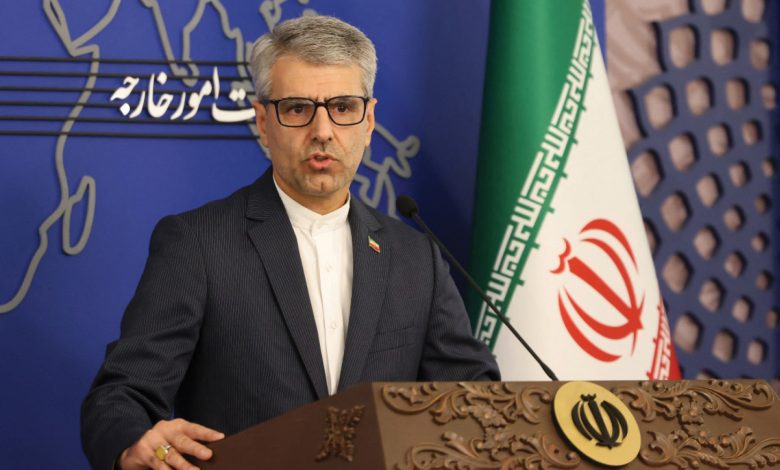
Iran has tied the reopening of the Strait of Hormuz to a sweeping list of political and financial concessions from the US, including full compensation for damage caused by what it described as two “imposed wars.”
The demands were set out on Saturday by Mohammad Bagher Zolghadr, secretary of Iran’s Supreme National Security Council, and reinforced on Monday by Foreign Ministry spokesman Esmaeil Baghaei.
The reparations demand was part of a broader set of conditions that included an end to US attacks and threats against Iran and its regional allies and an end to the US naval blockade and the withdrawal of US naval and air forces from the region. Iran also demanded the lifting of US sanctions and the unconditional release of frozen Iranian assets.
Iran’s foreign ministry spokesman Esmaeil Baghaei has tied the reopening of the Strait of Hormuz to a sweeping list of political and financial concessions from the US, including full compensation for damage caused by what it described as two “imposed wars.” (FILE/media)
President Donald Trump’s subsequent call for the Iranian government to pay compensation to the US and other countries “for the damage they’ve done over a 50-year period” is a reminder of the half century of death and destruction unleashed by the Islamic Revolution on the region and the world since 1976.
It also speaks to the deep enmity between the US and Iran, which began on Nov. 4, 1979, when Iranian militants seized the US Embassy and held more than 50 Americans hostage for 444 days.
That crisis — and the subsequent failed attempt by US forces to free the hostages, which ended in disaster in the Iranian desert and the deaths of eight American servicemen on April 24, 1980 — contributed to the collapse of Jimmy Carter’s presidency.
It may also have planted the seed of the future President Trump’s determination to deal a terminal blow to Iran’s theocratic regime. In October 1980, six months after the national embarrassment of Operation Eagle Claw, Trump, then a mere 34-year-old real estate developer and 36 years away from his first presidency, gave a television interview in which, to the surprise of his interviewer, he offered his first recorded views on US foreign policy.
“That this country sits back and allows a country such as Iran to hold our hostages, to my way of thinking, is a horror,” he said. America, he added, should have invaded, freed the hostages and taken over Iran’s oil fields. “I think right now we’d be an oil-rich nation,” he said. “That would have been the easiest victory we would have ever won, in my opinion.”
Today, almost 50 years on, as Tehran and its proxies continue to deal out death and destruction throughout the region, victory over Iran continues to prove far more elusive than Donald Trump’s younger self could ever have imagined. Trump’s call for reparations from Iran was made after Baghaei called on the US to end its blockade of Iranian ports, lift economic sanctions and pay compensation to “make amends for its illegal and destructive actions.”
It was, as Trump pointed out on Monday, a preposterous suggestion from a regime responsible not only for a litany of outrages imposed on its regional neighbors and their allies over the past half century, but also for the deaths of thousands of its own citizens.
For decades, in support of its own narrow, negative world view, Tehran and its terrorist proxies have meddled consistently and with deadly consequences in the lives of millions of people, in countries including Iraq, Syria, Lebanon, Yemen and all of the Gulf states.
One of the very first examples of the toxic philosophy of the fundamentalist theocracy of the Islamic Republic seeping out into the world was the seizure of the Grand Mosque in Makkah by armed fanatics on Nov. 20, 1979 — just 16 days after the US Embassy had been seized in Tehran. It took Saudi forces two weeks to end a siege that shocked Muslims around the world.
This handout satellite image courtesy of Vantor shows damage following a drone attack on a high-rise apartment building in Bahrain’s capital Manama on March 2, 2026. (FILE/media) At the time, the then Iranian leader, Ayatollah Khomeini, suggested the seizure of the mosque had been “perpetrated by the criminal American imperialism so that it can infiltrate the solid ranks of Muslims.”
It was, of course, preposterous. But it was enough to trigger anti-American riots in Pakistan, where a mob stormed the US Embassy in Islamabad, burning it to the ground and killing two US servicemen and two Pakistani members of staff. Similar protests in Tripoli also saw the US Embassy there destroyed, and the withdrawal of all personnel from Libya, to which American diplomats would not return for another 25 years.
President Trump has called on Iran to compensate all victims of its decades of violence — no more likely, of course, than the US making reparations to Iran — but clearly it is the suffering that has been endured by Americans that is uppermost in his mind.
On March 2 this year, just days after the joint US-Israel attacks that signalled the start of the current conflict, the White House posted what it called “only a partial record of the Iranian regime’s blood-soaked war on Americans.”
It added that “for nearly half a century, the Islamic Republic of Iran — the world’s leading state sponsor of terrorism — has killed and maimed American citizens and service members through its own forces and proxy militias. More Americans have been killed by Iran than any other terrorist regime on Earth.”
President Trump was “doing what Presidents over the last five decades have refused to do — eliminate the threat once and for all.” Over the years, that threat has been felt painfully and often by America.
US military started attacking Iranian targets in February, including bridges. (FILE/media) Iran claimed its first American lives on April 18, 1983, when Islamic Jihad, backed by Tehran, carried out a suicide car bombing at the US Embassy in Beirut, killing 63 people, including 17 Americans.
It was a moment of lost innocence — the building had no protective barriers around it. That lesson would be learnt, but not in time to prevent an even worse tragedy. On Oct. 23 that year, a truck bomb was detonated at a US Marines compound in Beirut, claiming the lives of 241 US personnel serving as part of a multinational peacekeeping force in Lebanon.
At almost the same time, another bomb killed 58 French soldiers. Both attacks were by Iran-backed Hezbollah. For America, over the coming decades the litany of outrages would be endless, and almost every branch of the US military and intelligence communities bears a grudge toward Iran’s orchestrators of terror.
Carved on a marble memorial wall inside the headquarters of the CIA in Langley, Virginia, for example, are more than 140 stars representing operatives who died in the line of duty, including more than a few killed by Iran or its proxy operators.
One of the stars honors William F. Buckley, who was CIA station chief in Lebanon following the 1983 Beirut Embassy bombing. He was abducted by Islamic Jihad in March 1984 and endured 14 months of captivity and torture before being murdered in June 1985. The Iranian slogan, “Death to America,” echoed throughout the 1980s and ‘90s.
In December 1984, Hezbollah terrorists hijacked Kuwait Airlines flight 221, diverting it to Tehran where they brutally murdered two American passengers who were working for the US Agency for International Development.
In June the following year, another hijack saw a TWA flight from Athens to Rome diverted to Beirut, where the Iran-backed Hezbollah hijackers tortured a US Navy diver before shooting him in the head and dumping his body on the tarmac.
In February 1988, US Marine Lt. Col. William Higgins, serving with the UN peacekeeping force in southern Lebanon, was kidnapped and held hostage until July the following year, when he was murdered by his Hezbollah captors.
In June 1996 Iran-backed Hezbollah Al-Hijaz terrorists killed 19 American airmen and wounded nearly 500 others in a truck bombing at Khobar Tower, a US Air Force housing complex in Dhahran, Saudi Arabia.
In August 1998, Al-Qaeda suicide bombers, aided and abetted by Iran-backed Hezbollah, bombed the US embassies in Kenya and Tanzania, killing 224 people, including 14 Americans. And so the list goes on and on.
Over the years, many families of American victims of Iran-sponsored terror have successfully sued Iran in US federal courts. Recently, a court in Washington awarded $573 million to families of US service members killed or injured by Iranian-supported terrorists in Iraq from 2003 to 2015.
No money, of course has been forthcoming from Tehran. But last month a delegation of families came to Washington to ask President Trump to ensure that “no agreement, interim or long-term, should release, transfer, unfreeze, or return Iranian assets, or lift or relieve sanctions, before the outstanding terrorism judgments owed to American victims are resolved.”
It remains to be seen what part, if any, reparations will pay in any final ceasefire agreement between America and Iran. But for thousands of Americans, as for the tens of thousands of families throughout the Middle East and North Africa impacted by Iran’s 50 years of terror, no amount of money will ever be enough to compensate for the losses they have endured. — DNA