Ahsan urges deeper regional connectivity, proposes four-point cooperation plan at Tian Shan Forum
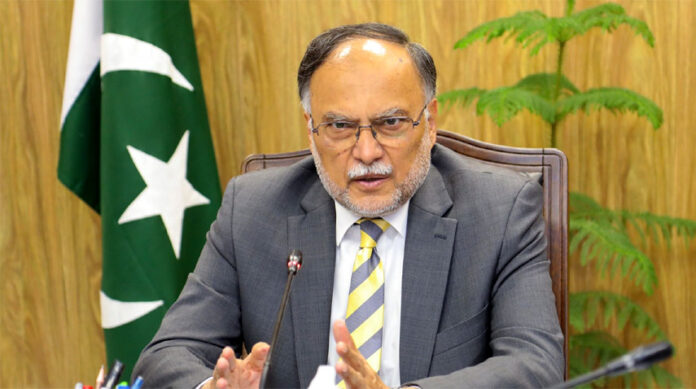
Federal Minister for Planning, Development and Special Initiatives Professor Ahsan Iqbal on Tuesday called for renewed commitment to regional connectivity, economic integration and long-term cooperation among China, Central Asia and South Asia, stressing that “great nations and great cultures do not rise in isolation; they flourish through exchange.”
In his televised address at the Tian Shan Forum on Economic Cooperation in Central Asia, being held in Urumqi (China) from December 2-3, the minister said the region, home to 3.9 billion people, was emerging as a major engine of global growth, with unmatched strategic and economic potential. “This is not a peripheral region. This is the heartland of the world’s future.”
Ahsan said the shifting global economic landscape demanded collective action and a development-centered approach. “Economic strength is moving from the Atlantic to the Indo-Pacific,” he observed, adding “Within our own region, China, Central Asia and South Asia are becoming a new pole of global growth.”
He said the Belt and Road Initiative (BRI) had revived the ancient spirit of the Silk Road through modern infrastructure, trade and people-to-people linkages. “More than 150 countries are now part of BRI, almost half a million jobs have been created globally and BRI transport corridors are projected to increase global rail income by 2 to 4 percent,” he noted.
Referring specifically to Pakistan, the minister said the China-Pakistan Economic Corridor (CPEC) was far more than a set of infrastructure schemes. “For Pakistan, CPEC is not just an infrastructure project – it is a strategic development framework built on trust and long-lasting partnership for mutual and regional prosperity,” he added.
The minister highlighted that CPEC had already added 8,000 MW to Pakistan’s national grid, built over 1,000 km of modern highways and motorways, operationalised Gwadar Port, initiated groundwork for special economic zones, and established a digital backbone for future cooperation in information technology and artificial intelligence. “CPEC’s success shows what regional cooperation can achieve when driven by clear purpose and commitment,” he said.
Ahsan underlined that Pakistan was reorienting its strategic paradigm from geopolitics to geoeconomics, with a clear objective to become the “most efficient, reliable and cost-effective connectivity hub” linking Central Asia, China, South Asia, the Middle East and global markets. Gwadar, he noted, offered the shortest maritime route for Central Asian republics, cutting transit time by up to 70 percent.
“Gwadar’s potential is regional, not just national,” he said. “It can become the anchor of a Eurasian supply chain complementing Western China and Central Asia.”
Envisioning a rapidly transforming integrated region, Ahsan said “Imagine a future where goods from Almaty, Bishkek, Dushanbe and Ashgabat reach global markets in days; where joint industrial clusters produce for the world; where energy pipelines, transmission lines and AI research centers create a regional knowledge economy. This future is not a distant dream – it is within our reach.”
To translate this vision into reality, the minister proposed a four-point cooperation framework and time-bound cooperation mechanisms.
First, he called for a joint task force on connectivity and economic integration, supported by harmonised railway and aviation routes, customs digitisation, single-window trading systems and coordinated border procedures. “Such harmonisation would reduce logistics costs by 20–30 percent across Eurasia,” he noted.
Second, he proposed regional special economic zones, jointly developed by Central Asia, Pakistan and China to build shared supply chains, promote manufacturing, encourage Central Asian investment in Gwadar and Karachi, and facilitate industrial cooperation. “Regional SEZs could generate $50–60 billion in industrial output within a decade,” he added.
Third, he suggested an Eurasian Energy and Clean Transition Partnership, focusing on electricity trade via CASA-1000-type grids, gas pipeline connectivity, renewable energy, hydropower collaboration, value chains for critical minerals and climate-resilient infrastructure. “At a time of global energy insecurity, this partnership can anchor stability for decades,” he remarked.
Fourth, Ahsan called for establishing a Digital Silk Road and Future Skills Alliance to promote cooperation in artificial intelligence, FinTech, cybersecurity, e-commerce, smart agriculture and youth innovation. “Our young population must become the architects of tomorrow’s economy,” he emphasised.
Highlighting shared regional challenges, including climate change, technological disruption and development gaps, the minister said no nation could overcome them alone.
He said initiatives like the Global Development Initiative, Global Security Initiative and Global Civilization Initiative, introduced by President Xi Jinping, provided a timely and people-centric framework for joint development. “These approaches deeply resonate with Pakistan’s vision,” he said.
The minister called for collective resolve, saying the 21st century would be shaped not by geography but by leadership and the choices nations make together.
“If we choose connectivity over isolation and cooperation over fragmentation, our region can emerge as the strategic economic center of the world. Pakistan stands ready, committed and optimistic. Together, we can build a future worthy of our rich history and heritage, a future of stability, innovation and shared prosperity,” he remarked.