Worker unrest shuts hundreds of garment factories in Bangladesh
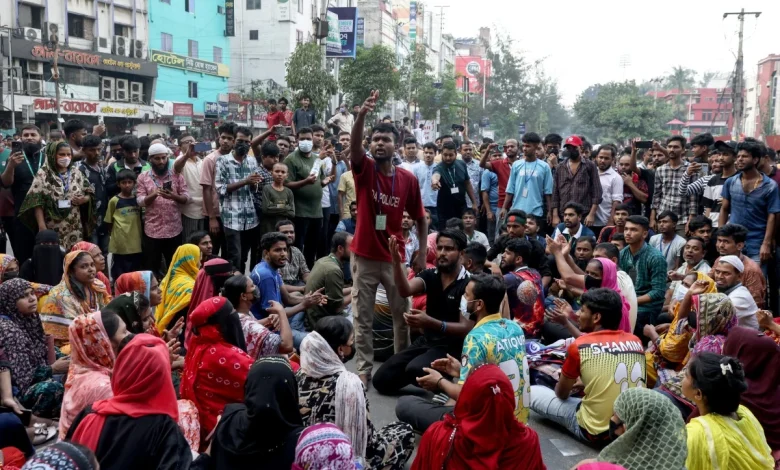
DHAKA: Hundreds of garment factories across Bangladesh were closed on Monday after hundreds of thousands of workers staged the largest protest in years to demand a rise in monthly wages.
The world’s second-largest exporter after China, the Bangladeshi ready-made garment industry is the backbone of its modern economy, accounting for 80 percent of export earnings, which reach $40 billion per fiscal year.
The sector is the largest formal industrial employer in the country, with around 4 million people working at 3,500 factories registered across major industrial hubs including Dhaka, Gazipur, Narayanganj, Chattogram, and Savar.
Millions more jobs are created in the ecosystem generated by the RMG industry, including in transport, packaging, and supply chains.
But despite contributing about 10 percent to gross domestic product, workers at garment factories have the statutory minimum wage of 12,500 taka ($100) per month — one of the lowest among garment-exporting countries.
As the cost of living has risen significantly since the wage was set in 2023, especially in the wake of a fuel crisis and rising inflation linked to the US-Iran war, unions are demanding an increase to 30,000 taka.
Following a series of smaller protests that began in mid-October, nearly 1 million workers have been blocking major streets in Dhaka and Gazipur since Sunday, clashing with police, and forcing hundreds of factories to temporarily shut down, according to the Bangladesh Garment Manufacturers and Exporters Association.
“For the second consecutive day, garment workers took to the streets in different parts of Dhaka, Gazipur and Savar, resulting in the closure of factory operations at around 700–800 factories,” BGMEA director Faisal Samad told Arab News.
“It will take some time to come up with a concrete proposal regarding the increase in wages. Definitely, it will happen soon. Previously, in such cases, it took around three months.”
As the unrest broke out, the government formed on Sunday a six-member wage board, including union and factory owner representatives, to review the workers’ demands.
“With this protest on the streets, there is pressure on the authorities … Now, discussions will take place, and there we hope that based on consensus and with the government’s mediation, they will be able to reach a solution,” said Mustafizur Rahman, distinguished fellow at the Center for Policy Dialogue in Dhaka.
“Owners understand that workers’ demands are justified, and that over the past three years in our country, inflation has been much higher than wage increases. Therefore, the purchasing power of workers has declined, which owners also understand,” he told Arab News.
“On the other hand, entrepreneurs are also facing various challenges — no gas, no electricity, many problems with high interest rates. Workers will surely consider this too. If sector competitiveness is not maintained and factories close down, there is no benefit for anyone.”