U.S varsity honors Pakistani academic for excellence in science communication
PESHAWAR
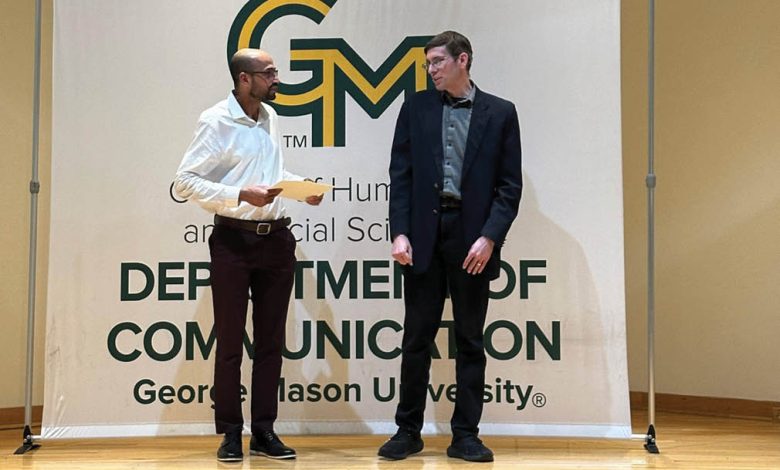
A Pakistani academic, Syed Muhammad Abubakar, has won the Joe Witte Special Recognition in Science Communication Leadership award by George Mason University (GMU), U.S.
Abubakar was nominated for this award on behalf of the communication graduate faculty at GMU for work in science communication and stellar performance in various courses as part of his ongoing PhD studies.
According to a press release issued here on Sunday, Dr. Chris Clarke, Associate Professor and Director of PhD in Communication Program, GMU, “Science communication is a key focus of our graduate program, especially within the PhD program. The Joe Witte Special Recognition in Science Communication is awarded to a student who demonstrates excellence in science communication research and scholarship.
The award is named in honor of Joe Witte, who received his MA in Science Communication at George Mason after a decades-long career as a professional broadcast meteorologist.
Dr. Clarke further said, “Abubakar, as we know him, is a second-year PhD student who came to George Mason’s PhD program in Science Communication as an award-winning, Pakistan-born and raised journalist with a passion for climate change communication and climate journalism.
He is currently pursuing research on challenges Pakistani journalists face in reporting on climate change, along with potential solutions to strengthen their reporting capacity.
“As one Mason COMM faculty member put it, Abubakar is highly dedicated to his craft and passionate about the intersection of climate change communication and journalism,”Clarke remarked.
Expressing his comments, Syed Muhammad Abubakar said, “It is an honor to receive the prestigious Joe Witte Special Recognition in Science Communication Leadership award at GMU. South Asia and the Hindu Kush Himalaya (HKH) region are highly vulnerable to climate change. It is important to highlight the vulnerability of this region and to understand how the people of this region perceive climate change in their everyday lives, so that we can develop strategies to raise awareness and foster climate action.
The media has an important role to play by informing vulnerable communities of the climate risks and mobilizing them in the wake of climate disasters, such as Glacial Lake Outburst Floods (GLOFs), flash floods, heatwaves, and cloudburst events, among others, Abubakar added.
He further said, “The 2025 floods cost the government Rs. 822 billion (US$ 2.9 billion), over 1,000 deaths and massive destruction of public and private infrastructure, according to an assessment by the Ministry of Planning, Development & Special Initiatives.
This year as well, there is a potential threat of Glacial Lake Outburst Floods (GLOFs), heatwaves are already affecting the southern part of the country, and an unpredictable monsoon season threatens Pakistan’s predominantly agrarian economy.
We need to develop effective early warning messages to save lives and minimize economic losses, he stressed.
The national media, including print, electronic and digital media, need to translate these early warning messages into easy-to-understand local languages, so that vulnerable communities are well-informed and timely protected from these climate-induced natural disasters. In this age of adaptation, timely information about potential risks with necessary solutions is key to saving lives and livelihoods.
It merits to mention here that Syed Muhammad Abubakar is a Graduate Teaching Assistant (GTA) and PhD Scholar in the Department of Communication at GMU since 2024. His research interests include climate change communication, climate journalism, and the intersection of climate and health in the communication field. He has taught courses on environmental communication, journalism, and communication at GMU and has presented conference papers at science conferences at GMU.
Abubakar is also affiliated with the Mason Center for Climate Change Communication (Mason 4C) and focuses on the Global South and the Hindu Kush Himalaya (HKH) region.
He is also the recipient of the 2019 Environmental Journalist Award and the 2015 Young Environmental Journalist Award by the Singapore Environment Council (SEC).