SECP, IRC Discuss Broader Access to Finance and Women’s Economic Empowerment
David Miliband commends SECP’s ambition to broaden financial participation, stresses the importance of linking social development with economic empowerment
ISLAMABAD
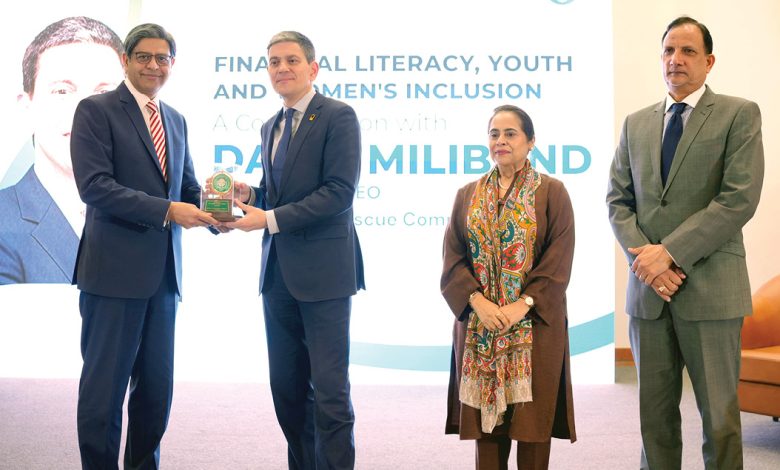
The Securities and Exchange Commission of Pakistan (SECP) organized a session on “Financial Literacy, Youth and Women’s Inclusion” under its SECP Talk Series, with David Miliband, President and Chief Executive Officer of the International Rescue Committee (IRC), delivering the keynote address.
In his address, Miliband underscored the importance of integrating economic empowerment into social development initiatives. Recalling visits to communities in Pakistan, including Haripur, where he observed IRC-supported livelihood initiatives and a rehabilitated basic health unit, he said social interventions were more effective when accompanied by opportunities for economic advancement. Drawing on IRC’s experience across 40 countries, he highlighted healthcare as an area where complementary economic measures could strengthen impact.
Miliband commended SECP’s ambition to broaden financial participation and expressed interest in collaborating on financial literacy, women’s economic empowerment and opportunities for underserved communities.
Chairman SECP Dr. Kabir Ahmed Sidhu identified limited financial literacy as a major barrier to public participation in financial markets.
He outlined SECP’s investor education initiative with capital market institutions, noting that its outreach ambition had expanded from 2.5 million to five million people. He also highlighted the revamping of the Institute of Financial Markets of Pakistan and a digital application designed to simplify investor onboarding.
The Chairman emphasized that investor protection and public trust remained central to SECP’s work and welcomed collaboration with IRC.
SECP officials highlighted the Women Equality in Finance Policy, financing options for women-led businesses and educational outreach. Women constitute 81.9 per cent of non-bank microfinance companies’ active borrowers, representing 3.08 million women.
These companies disbursed Rs. 236.2 billion to women during FY2026.
Potential collaboration areas included community financial education, training local facilitators, developing Urdu and Pashto learning materials, and improving awareness of financial services among women and crisis-affected communities.