€12.2bn Pak-EU trade opens scope for more investment, B2B links: EU Envoy
Ambassador Raimundas Karoblis in meeting with APBF sees scope for further economic growth

Islamabad
The European Union Ambassador to Pakistan has said there is significant scope for expanding economic and commercial relations between Pakistan and the European Union through higher exports, greater investment, technology transfer and stronger business-to-business (B2B) cooperation.
The EU Ambassador Raimundas Karoblis was talking to All Pakistan Business Forum (APBF) delegation, where the two sides discussed bilateral trade and investment, joint ventures, GSP+ market access, small and medium-sized enterprises (SMEs), technical and vocational education and training (TVET), and emerging regulatory requirements in the European market.
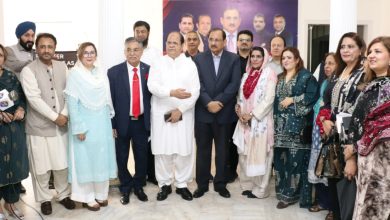
The meeting was attended by APBF President Syed Maaz Mahmood, Secretary General Amir Munir Malik, Mian Faheem Qamar, Patron-in-Chief of Sundar Trade and Industry Association, Haroon Ali Khan, Chairman Pakistan Chemical Manufacturing Association, Shahzad Azam, Chairman PIEDMC, Brigadier (R) M. Sajid Khokhar, Chairperson TEVTA Punjab, Nasir Ali Zia, Director Masood Textile, Aziz Ullah Goheer, Secretary General Pakistan Textile Exporters Association, M. Naeem, Zohaib Butt and other business leaders.
The ambassador said Pakistan had benefited considerably from the GSP+ scheme and stressed that the country could further benefit by fully implementing ILO Conventions diversifying its export base, increasing value addition and developing skilled workforce.
According to the latest European Commission assessment, Pakistan’s exports to the EU reached about €8.3 billion, with the EU accounting for around 28% of Pakistan’s total exports.
The EU remained Pakistan’s largest export market, while textiles and clothing constituted roughly 75% of Pakistan’s exports to the bloc. In 2025, bilateral trade in goods between the EU and Pakistan stood at €12.2 billion.
Karoblis emphasised closer interaction between Pakistani and European businesses to identify new areas of commercial cooperation. He also highlighted the importance of skills development and workforce preparation.
APBF appreciated EU support for technical and vocational education and training, saying a better-skilled workforce could serve both Pakistan’s domestic economy and overseas labour markets.
EU-supported TVET programmes have focused on demand-driven skills and employment opportunities, while an evaluation of the TVET III programme recorded 118,946 competency-based training graduates and 19,530 workplace-based trainees.
Pakistan’s overseas workforce is also an important source of foreign exchange. Workers’ remittances reached a record $41.6 billion in FY2025-26, with remittances from EU countries contributing about $5.23 billion during the year.
APBF President Syed Maaz Mahmood said Pakistan’s business community wanted stronger and more practical economic engagement with the EU, particularly through B2B contacts, investment and joint ventures.
He also called for greater support for SMEs to meet European certification, documentation and compliance requirements and make fuller use of GSP+ market access.
Maaz Mahmood said SMEs constituted a major part of Pakistan’s economic base but many smaller businesses faced difficulties in meeting the cost of international certifications and increasingly stringent European standards. Technical assistance and easier access to information, he said, could help Pakistani SMEs enter European supply chains and expand exports.
The APBF president also briefed the EU envoy on the forum’s initiatives to develop business linkages between Pakistani enterprises and international markets, saying the organisation was ready to facilitate direct interaction between Pakistani and European businesses through B2B meetings, sector-specific linkages and joint ventures.
APBF Secretary General Amir Munir Malik welcomed Ambassador Karoblis and his team. APBF members shared sector-specific views and highlighted challenges faced by SMEs in meeting international standards, obtaining certifications and completing documentation for foreign markets.
During the interaction, the participants of the meeting said stronger technical cooperation with European institutions could help Pakistani companies improve production standards, meet environmental and social requirements and become more competitive in international supply chains.