Interior Minister highlights intelligence, military coordination & national unity during recent conflict
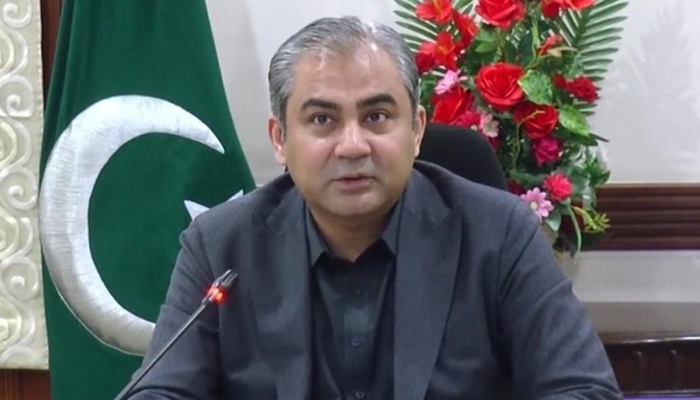
Minister for Interior said on Thursday that Pakistan’s civil armed forces, intelligence agencies and media played a decisive and exemplary role during the recent Pakistan-India hostilities, ensuring national security through advance preparedness, effective coordination and remarkable unity.
Speaking at a briefing, the minister thanked media representatives for attending and said the visit coincides with nationwide celebrations, making it important to highlight how civil defence, Rangers, Islamabad teams and other forces performed their duties with exceptional commitment.
He said that while the armed forces — the Army, Air Force and Navy — played an outstanding role, the contribution of Pakistan’s intelligence agencies was “far greater than acknowledged.” According to him, advance intelligence during the conflict proved “100% accurate,” enabling Pakistan to prepare and respond effectively.
The minister revealed that India used drones extensively, sending small and medium-sized drones across several Pakistani cities. Pakistan, however, intercepted and downed most of them at the border. “Our Rangers shot down dozens of drones using only their guns. Very few managed to reach cities,” he said.
He added that India launched nearly 100 attacks on Pakistani border posts but “received the response they deserved.” Images of Indian forces raising a white flag along the Line of Control speak for themselves, he said.
The minister also highlighted India’s cyber-attack attempts, saying they “failed completely” due to Pakistan’s superior cyber response capabilities. “Nothing on their side remained secure,” he noted.
Praising the Pakistani media, he said it maintained unity and a single national voice, unlike Indian media which “remained confused and even reported self-inflicted attacks.” Pakistan, he added, maintained a clear stance: “Whenever we respond, we will do it openly, not secretly.”
He recounted several instances in which key military decisions succeeded against the odds, crediting them to divine support. He said Pakistan narrowly avoided large-scale losses during a major missile attack on a Balochistan airbase. “Out of 16 missiles fired, only one hit the base; the rest were diverted. This was not possible without God’s blessing.”
Similarly, Pakistan’s missiles struck critical Indian military targets with precision, avoiding civilian areas. “A slight deviation could have hit populated zones, but every missile struck exactly where it was meant to,” he said.
The minister stressed that numerous major Indian Navy and Air Force assets were within Pakistan’s range, prompting India to accept the ceasefire. “Had the ceasefire not occurred, India’s losses would have been ten times greater.”
He praised the coordination between the Field Marshal, the Air Force Chief and other service chiefs, noting that the Air Chief spent nearly two weeks inside the operations room. “Such commitment and leadership were unprecedented.”
He emphasized that Pakistan’s intelligence agencies played a decisive role by providing advance and accurate information throughout the conflict. “Their performance shocked even people like me. It was as if every detail was coming from within India.”
He also acknowledged the crucial role of the Information Ministry and ISPR in managing wartime communication, ensuring accurate and responsible dissemination of information. “ISPR handled an extremely difficult task with excellence, deciding what could be shared during wartime and how.”
He concluded by urging the nation to preserve the unity demonstrated during the conflict. “Unity was our greatest strength then, and it must remain so. Divisions weaken nations; unity wins battles.”