Zahid Hussain welcomes IMF staff-level agreement amid global turmoil
Urges strategic resilience against regional war spillovers
Karachi
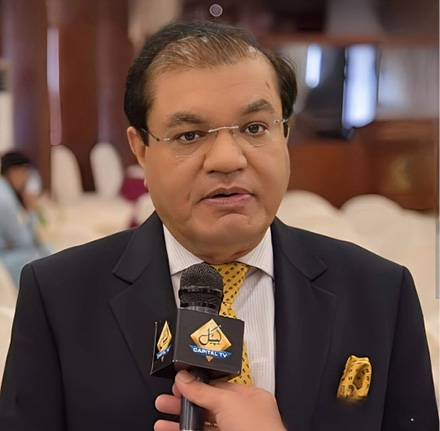
Mian Zahid Hussain, President Pakistan Businessmen and Intellectuals Forum & All Karachi Industrial Alliance, Chairman National Business Group Pakistan, Chairman Policy Advisory Board FPCCI, and Former Provincial Minister Information Technology, has expressed satisfaction over the successful conclusion of the third review of the 37-month Extended Fund Facility (EFF) and the second review of the 28-month Resilience and Sustainability Facility (RSF) with the International Monetary Fund (IMF).
The business leader noted that the staff-level agreement, which paves the way for a $1.2 billion disbursement—comprising approximately $1 billion under the EFF and $210 million under the RSF—comes at a critical juncture as Pakistan navigates a highly volatile regional environment. He highlighted that this brings the total disbursements under the current arrangements to $4.5 billion, providing a much-needed buffer for the country’s external account.
Mian Zahid Hussain stated that the IMF’s endorsement of Pakistan’s macroeconomic stability is reflected in the achievement of a primary surplus of 2.8 percent during the first half of FY2026. However, he warned that the escalating US-Israel-Iran conflict, which intensified following the strikes on February 28, poses a grave threat to these gains. He pointed out that the blockade of the Strait of Hormuz has already disrupted nearly 20 percent of global oil and LNG trade, causing Brent crude to spike to $120 per barrel earlier this month. While prices moderated to approximately $103 per barrel in the last week which have again increased to $115 per barrel resulting in the 64 percent surge in oil and 143 percent hike in LNG benchmarks continue to strain Pakistan’s import bill.
The veteran business leader emphasized that every $10 increase in oil prices adds nearly $1.5-$2 billion to Pakistan’s annual import costs, potentially widening the external financing gap at a time when the country is targeting a primary surplus of 1.6 percent of GDP for FY2026. He remarked that the IMF’s conditions, including maintaining a tight monetary policy and a market-determined exchange rate, are essential “shock absorbers” against Middle Eastern spillovers. He lauded the government’s commitment to broadening the tax base and strengthening the Benazir Income Support Program (BISP) to protect the vulnerable from energy-led inflation, which remains a concern despite dropping to 5.2 percent in the first half of the fiscal year.
Mian Zahid Hussain further observed that the regional war threatens the $21 billion annual remittance flows from the GCC, which are vital for financing the current account deficit. He noted that the 40 percent increase in fertilizer prices and 85 percent rise in European gas benchmarks due to the conflict are particularly lethal for Pakistan’s agrarian economy. He urged the authorities to implement a comprehensive economic contingency framework, as the IMF program now requires even stricter fiscal discipline and structural reforms in the energy sector and State-Owned Enterprises (SOEs) to ensure debt sustainability.
The Chairman NBG concluded by stating that while the IMF agreement offers a significant “breather,” Pakistan must diversify its energy sources and strengthen diplomatic efforts to safeguard its economic interests during the US-Israel-Iran war. He stressed that the successful completion of the IMF reviews is a testament to the country’s resilience, but the government must remain vigilant as global food and fuel price volatility could easily derail the projected GDP growth of 3.2 percent for the current fiscal year.