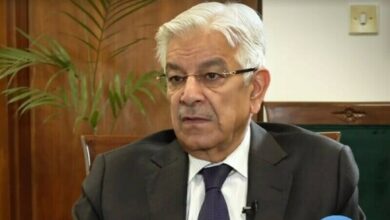
CM Afridi reviews progress of safe cities project in KP
The project set for completion by Jan 31, 2026

PESHAWAR: Khyber Pakhtunkhwa Chief Minister Muhammad Sohail Afridi on Tuesday chaired a high-level meeting to assess the province-wide implementation of the Safe Cities Project.
According to a statement, the meeting focused on the operational progress, planned expansion, and the legal and institutional frameworks necessary to support the initiative.
Officials emphasized the project’s role as a cornerstone in enhancing public safety and strengthening law enforcement in the province.
The meeting reviewed the on-ground developments in key districts, including Peshawar, Dera Ismail Khan, Bannu, and Lakki Marwat, with particular attention given to the installation of surveillance infrastructure, phased system activation, and the establishment of Integrated Command, Control, and Communication Centers (ICCCs).
Officials briefed participants on the ongoing installation of surveillance cameras and supporting infrastructure across major roads, intersections, and key entry and exit points in Peshawar.
The Chief Minister was informed that the Peshawar Safe City project is on track for completion by January 31, 2026.
In addition to the capital, parallel work is progressing in Dera Ismail Khan, Bannu, and Lakki Marwat.
Surveillance networks and command and control systems are being rolled out in stages across these districts, with 88 locations in Dera Ismail Khan, 76 in Bannu, and 47 in Lakki Marwat set to be brought under camera coverage. These districts are also expected to go live by the end of January 2026.
The meeting was further briefed on the finalized PC-1 documents for the Safe Cities Project in Karak, Tank, and North Waziristan. Preparatory work, including site identification and security assessments, has already been completed in these areas. A dedicated implementation framework tailored for the merged districts was also discussed, addressing terrain, security conditions, infrastructure gaps, and operational requirements.
The Chief Minister directed that, following the completion of ongoing projects, the Safe Cities network be expanded to other divisional headquarters in a phased manner. He emphasized that the expansion should be driven by security priorities, population density, and operational feasibility.
In an effort to maximize the utility of existing surveillance infrastructure, the meeting decided to map and integrate CCTV cameras installed at hotels, commercial plazas, residential areas, housing societies, and other private premises into the Safe Cities network. The integration will adhere to technical standards, legal requirements, and privacy safeguards. Furthermore, cameras installed in educational institutions, especially schools, will be linked to the system wherever feasible.
With the scope of the project expanding rapidly, Chief Minister Afridi also directed that proposals be submitted for the establishment of a Safe Cities Authority. The proposed authority will address governance, lawful use of surveillance data, admissibility of digital evidence in investigations and court proceedings, data protection, citizens’ privacy, inter-agency access, and the recruitment and training of technical personnel.
The Chief Minister emphasized that the framework for the authority must ensure strong institutional foundations to support the Safe Cities initiative in the long term. He further instructed that a 24-hour solar-powered energy supply be guaranteed for Safe Cities infrastructure in the merged districts, underscoring the provincial government’s commitment to bringing modern technology to remote and sensitive areas.
Addressing the meeting, Chief Minister Sohail Afridi reiterated that the Safe Cities project would be rolled out in phases across the province.