Senate passes 26th constitutional amendment bill
PTI attends Senate session but opts out of the voting process | remaining members of Senate vote in favour of 22 clauses of the bill
Islamabad
Senate has passed the Constitution (26th Amendment) Act, 2024, with members of the House voting in favour of 22 clauses.
The bill, better known as the Consti¬tutional Package, is legislation proposing a set of constitutional amendments, including the extension of the chief justice’s term. A special parliamentary committee formed last month — which has the representation of all parties, including the PTI — had been discussing various proposals.
The bill, which was approved by the federal cabinet earlier in the day with the consensus of the government’s coalition partners, was presented in the Senate today by Law Minister Tarar.
According to a statement from the Prime Minister’s Office (PMO) released in the afternoon today, the cabinet decided to approve the bill “in the wider interest of the country while adhering to the oath of national development and public welfare.” At the beginning of the session, the law minister presented the bill following which senators delivered their speeches.
Once the bill was officially tabled, Senate Chairman Yousaf Raza Gilani read out the contents of the amendment bills and asked lawmakers to cast their votes.
Speaking about speculations regarding the extension of the chief justice’s tenure in the Constitutional Package, Tarar clarified that Chief Justice Qazi Faez Isa was not interested in any extension.
“During the three meetings that I had with the top judge, he reiterated his disinterest in the extension of his tenure, saying that any amendments would come into effect after his retirement,” Tarar said.
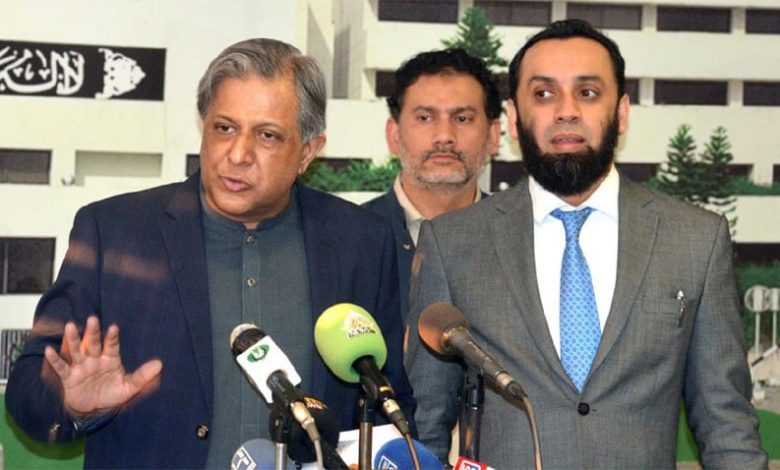
Before the Senate session, the law minister also addressed a press conference at Parliament House, flanked by Information Minister Attaullah Tarar. During the presser, he outlined the contents of the bill and said that a constitutional bench would be formed by a judicial commission led by the Chief Justice of Pakistan (CJP).
“Before the 18th Amendment, judges were appointed by the President on the advice of the PM,” Tarar said.
“This ‘new-face’ commission will be made up of the CJP, four of the senior-most Supreme Court judges, two senators and two MNAs — one of each will be from the opposition,” the law minister said. “We are aiming to achieve a broader consensus with this commission,” he added.
The minister said that he and the attorney general will also be a part of the commission.
“Marginalised communities and those whose fundamental rights need to be enforced, such as women and minorities, will be appointed by the National Assembly Speaker,” he added. “We will also bring in someone from outside parliament as a technocrat, who can provide input based on their experience.”
In terms of the provincial judiciary, Tarar also said a performance evaluation system was being introduced to assess the performance of judges.
“People complain that their cases are pending for up to 10 years,” he said. “This judicial commission needs to enforce a nationwide standard, so the performance of high court judges will be evaluated.”
Tarar continued: “We need to appreciate the judges who perform well, but in the past, we have received complaints that after confirmation, their work is inadequate. We need to ensure that taxpayers’ money is being well spent, and when the judiciary is receiving such perks, we expect results. “Cases where there is inefficiency will be referred to the Supreme Judicial Council,” he added.