WHO has been preparing for ‘worst-case scenario’ in Lebanon, regional chief tells Arab News
NEW YORK: The escalation in the conflict between Israel and Hezbollah is of “grave concern” for the World Health Organization, and the agency is exerting substantial efforts in ensuring that countries in the region are “ready for the worst-case scenario when it comes to health preparation,” WHO’s regional chief has told Arab News.
Dr. Hanan Balkhy, a Saudi physician who was appointed to the role of director for the Eastern Mediterranean in January this year following a distinguished career in medicine, made the comment while she was in New York City last week to rally support for critical public health initiatives.
“When it comes to the health preparation, we were able over the past months to pre-place emergency kits within Lebanon and with a few other neighboring countries to at least sustain some of the commodities that would be needed in case the escalation reached a very high point,” she told Arab News.
“We work very closely with the ministers of health, within the ministries themselves, and we make sure that we can train people on certain skills that we know will be necessary.”
The agency has conducted “hundreds” of training sessions — including mass casualty training, health workforce training and EMT training — within Lebanon and other WHO member states in the region.
Some of those countries have already faced significant pressure on their healthcare systems as a result of Israel’s war in Gaza, Balkhy said.
“There’s big pressure on the member states that are surrounding the Occupied Palestinian Territories, from receiving the (Palestinian) patients and taking care of them, but now there’s actual escalation of war in southern Lebanon.
“So, with that in mind, we’re trying to put together at least the basics that are needed for the worst-case scenario.”
Balkhy voiced concern over the recent pager and walkie-talkie explosions across Lebanon.
On 17 and 18 September 2024, thousands of handheld pagers and hundreds of walkie-talkies intended for use by Hezbollah operatives exploded simultaneously across Lebanon and Syria in an Israeli attack, killing dozens, including two children, and injuring thousands more.
Most of the dead are believed to have been fighters, based on death notices posted online by Hezbollah, the Iran-backed Shiite militia.
UN High Commissioner for Human Rights Volker Turk has called for an “independent, thorough and transparent investigation” into the mass explosion, adding that “simultaneous targeting of thousands of individuals, whether civilians or members of armed groups, without knowledge as to who was in possession of the targeted devices, their location and their surroundings at the time of the attack, violates international human rights law and, to the extent applicable, international humanitarian law.”
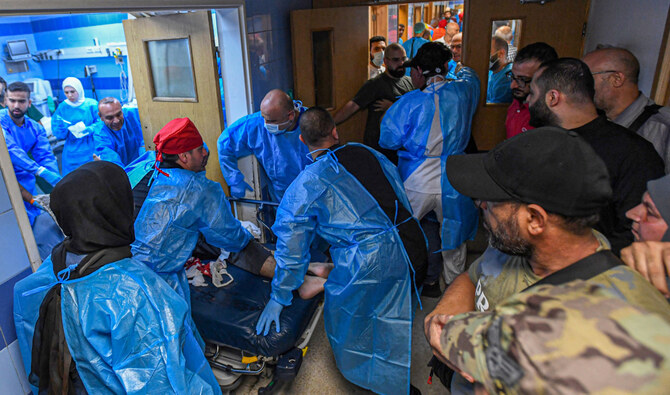
The device explosions led to “very complex injuries in the face and in the hands,” said Balkhy.
Doctors in Lebanon say they had never seen the kind of maiming that resulted from the pager attacks. Described some of the wounds as “horrific,” they said the injuries have ranged from puncture wounds in the face, amputated hands, ruptured eyeballs, abdominal wounds, ruptured bones, and broken jaws.
“We’re looking and seeking to find experts that can help us in identifying the best methods of treatment and how we can support the Lebanese Ministry of Health,” Balkhy said, pointing to “empathy” between member states and “a strong sense of solidarity.”
Balkhy also oversees WHO operations in Gaza, where the healthcare system is “on its knees” according to the UN.
“None of the healthcare facilities are fully functioning,” said Balkhy who witnessed the stark reality of the situation during a visit to Gaza and the West Bank in July.
Over 500 healthcare workers have been killed by Israeli airstrikes since the beginning of the war in October last year, and where out of 36 hospitals, 17 remain only partially functional. Primary healthcare and community-level services are frequently suspended in the battered enclave, due to insecurity, attacks and repeated evacuation orders.
More than 22,500 Palestinians have suffered life-changing injuries since Israel launched its military campaign in retaliation for a Hamas-led attack on southern Israel on Oct. 7 during which militants gunned down civilians and snatched people in towns, along highways and at a techno music festival.
Medical staff operating in Gaza are under “significant amounts of pressure and stress,” Balkhy said, with surgeons forced to operate in increasingly makeshift facilities, often without access to basic medical equipment.
“The healthcare facilities are not just buildings. They are buildings, they are medication and instruments, and commodities, they are also the health workforce.
“There’s not one single individual (in Gaza) who has not been faced (with) being asked to move from one point to another.
“Many of them have moved many, many times, but also with the deaths and the losses within their family.”
Yet healthcare workers “continue to stand on their feet and provide care when appropriate,” Balkhy added.
However, the type of traumas and injuries inflicted on Palestinians have been “unprecedented” and “devastating,” requiring “very complex healthcare systems” of the type that Gaza lacks, she said.
“Those who have been working in the humanitarian field for over a decade have acknowledged that the types of compound fractures, soft tissue injuries, skull injuries … need neurosurgeons.
“You need very sophisticated orthopedic surgeons. You need very sophisticated equipment.”
In response, the WHO has worked in tandem with member states to organize medical evacuations across the Middle East and beyond.
Since October 2023, over 5,000 patients have been evacuated for treatment outside Gaza, with over 80 percent receiving care in Egypt, Qatar and the UAE, and a further 10,000 patients are currently in need of medical evacuation for specialized care.
This includes newborn babies requiring intensive care whose families are trying to evacuate them following the bombing of specialist maternity units across Gaza.
Another major concern of health officials has been the growing lack of clean water and sanitary conditions in Gaza.
Hundreds of the enclave’s water filtration and sanitation facilities were destroyed by Israeli airstrikes since the beginning of the war.
Balkhy said that the lack of clean water makes it “very difficult” to provide the basics of healthcare.
She also highlighted the worrying proliferation of mental trauma among the population in Gaza.
“The last thing that worries me and that I saw of significance was what we will be facing from the mental stress disorders among the people who remain there and that will continue to work there.
“We will need, as the WHO, with partners, to help support, rehabilitate and address some of these issues.
“So, there’s a lot. The environment, which is a crucial part of the health and wellbeing of individuals, is extremely disturbing.